Show the right message.
Align channel, audience or search intent, geography, offer, creative, budget, and account structure.
Google & Meta advertising support
Advertising can waste money when targeting, offers, landing pages, forms, and conversion actions are disconnected. We help businesses set up, review, and improve Google Ads and Meta Ads around a specific customer action, then use the best available inquiry and outcome evidence to guide practical decisions.
Ad spend is paid to the platform and is separate from service fees. Campaign performance, lead quality, sales, revenue, and profitability are not guaranteed.
Platform conversions help optimize campaigns. CRM, sales, and commerce records are needed to evaluate later customer outcomes.
Good advertising work connects the campaign to the page, the page to an action, and that action to enough business context to improve the next decision.
The complete decision chain
Improving only the ad account can miss a weak offer, confusing page, unreliable form, or follow-up problem.
Align channel, audience or search intent, geography, offer, creative, budget, and account structure.
Send the click to a focused page that matches the ad and makes the next action clear on mobile.
Test suitable forms, calls, bookings, purchases, and platform conversion actions without treating every click as success.
Where data supports it, compare platform actions with qualified inquiries, appointments, sales, or other later milestones.
Important distinction: advertising platforms report attributed actions under their own settings and models. Actual inquiries and later customer outcomes require the corresponding website, CRM, sales, call, or commerce evidence.
Ways we can help
The engagement can be a defined setup, an account and landing-page review, or ongoing optimization with agreed responsibilities.
Plan Google or Meta campaign structure, targeting, creative inputs, budget boundaries, landing destinations, and conversion actions.
Review settings, search terms or audiences, geographic reach, exclusions, assets, goals, landing pages, and measurement health.
Create or improve focused pages with clear offers, mobile actions, trust information, and supported forms or booking paths.
Review spend, delivery, terms, audiences, creative, actions, lead quality, and available customer outcomes at an appropriate cadence.
Illustrative service-business scenario
A campaign should answer a business question—not just produce more platform activity.
A local service business runs Google and Meta campaigns to a broad homepage. Calls, short contact forms, detailed quote requests, and accidental submissions are counted together. The business sees clicks and conversions but cannot tell which campaign produced a useful conversation.
Each campaign has an appropriate destination and a primary action. Tracking distinguishes the initial inquiry from later qualified stages when the business records support them.
This scenario is illustrative, not campaign data or a forecast. Results depend on the offer, market, budget, competition, creative, page, sales process, and other factors.
Approved configuration evidence
For Generis Organization, the life insurance agency we operate, we configured distinct Google Ads conversion actions for form and call inquiries, qualified appointments, submitted applications, and later operational milestones.
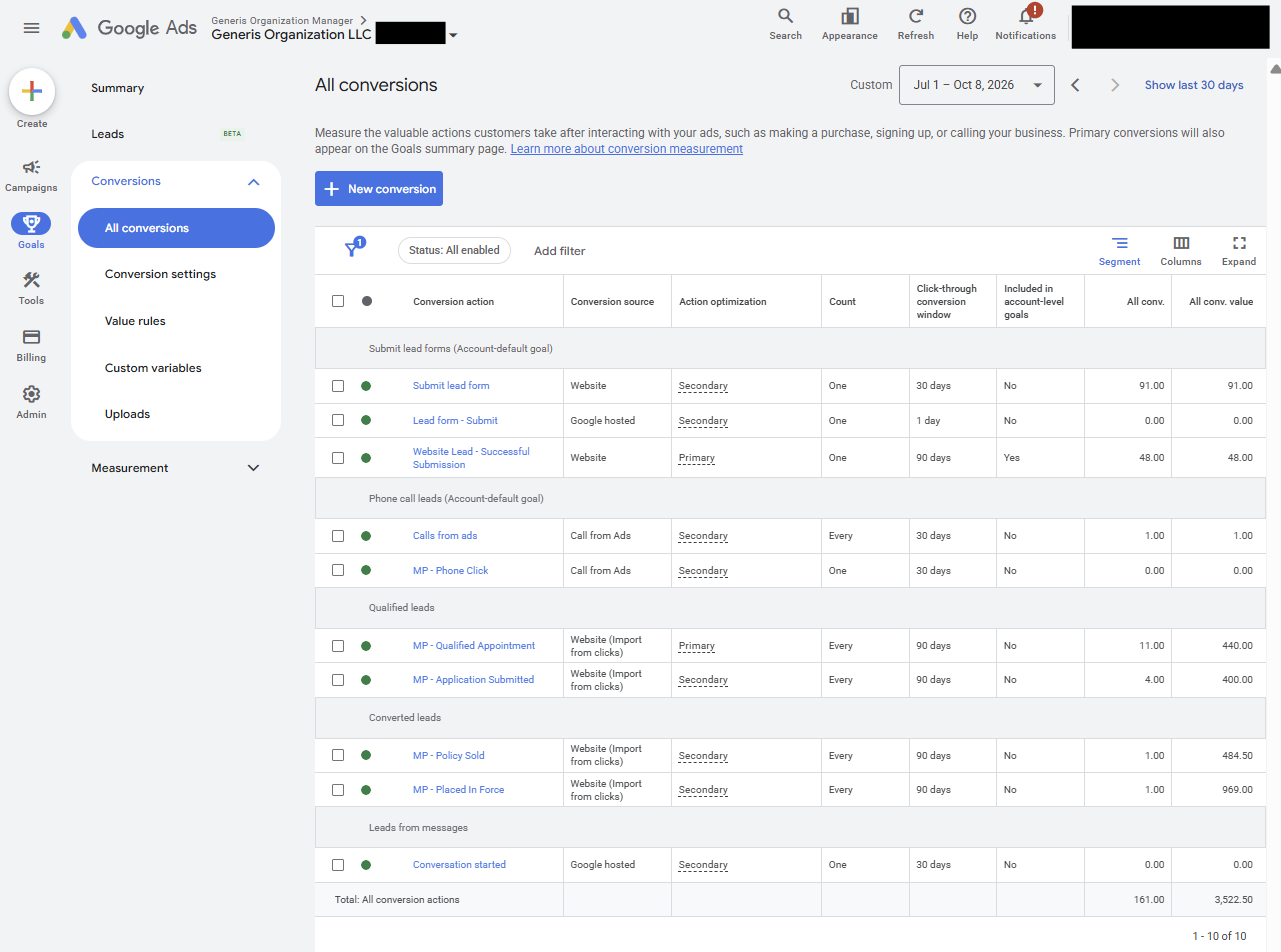
The historical view shows separate conversion actions with distinct reporting roles, counting settings, and windows. That structure can support better questions about campaign quality than one undifferentiated total.
Paid media versus analytics
Keeping the scopes clear prevents an ad-management project from becoming an undefined rebuild of every reporting system.
This service centers on campaign setup or review, targeting, search terms, audiences, ads, creative requirements, landing-page alignment, budget decisions, and ongoing platform optimization.
The separate analytics service centers on GA4, Google Tag Manager, event design, debugging, cross-channel website behavior, reporting definitions, consent-aware implementation, and measurement documentation.
How we work
The account should be built around the business’s actual offer, customer path, budget, and ability to follow up.
Define the customer, geography, action, lead-quality criteria, sales path, budget constraints, and evidence the business can provide.
Review access, ownership, history, settings, campaigns, creative inputs, landing pages, forms, and existing conversion definitions.
Implement the approved campaign, page, tracking, and handoff work with consent and platform-policy boundaries.
Validate important actions, then review enough delivery and business evidence to make proportionate changes without overreading small samples.
Connected services
Paid media works inside a larger customer path. These services can be scoped separately when the campaign reveals another problem.
Common questions
No. We can improve campaign, page, tracking, and review practices, but results depend on demand, competition, budget, offer, creative, customer experience, follow-up, platform behavior, and other factors outside our control.
Yes, when the channel fits the business goal and the required account, creative, landing-page, consent, and measurement inputs are available. A project may cover one platform rather than both.
Yes. A scoped review can examine ownership, access, settings, campaigns, search terms or audiences, goals, landing pages, tracking, and available lead-quality evidence. We document the most important issues before proposing changes.
No. Ad spend is paid directly to the advertising platform and remains separate from setup, management, landing-page, creative, tracking, software, and other project costs unless a written scope states otherwise.
Paid advertising support focuses on campaign and budget decisions, including the landing page and conversion actions needed for those decisions. The analytics service goes deeper into GA4, Google Tag Manager, event design, debugging, and cross-channel website measurement.
Spend with a clearer question
Tell us what you are advertising, who you want to reach, what a useful inquiry or purchase looks like, and what happens next. We’ll help define the campaign, page, tracking, and review work needed for a practical paid-media scope.