Important services have no useful page.
Build or improve focused pages that answer real customer questions instead of forcing every search onto a generic homepage.
SEO & local search
When search engines cannot clearly connect your services, locations, website, and business details, potential customers may find a competitor or reach a page that does not answer their question. We help improve the content, structure, local signals, and technical foundation that support discovery in Google, Bing, maps, and AI-assisted search.
Search visibility depends on relevance, location, competition, reputation, platform eligibility, and many factors outside any provider’s control. Rankings, map placement, traffic, and AI citations are not guaranteed.
Clear service details, location context, trustworthy business information, and an obvious way to request help.
Accurate hours, areas served, contact information, and links that lead to a useful page.
Useful SEO connects the questions customers ask with pages that explain the service, show why the business is relevant, and make the next step easy.
Problems we help solve
Small gaps in pages, business details, and technical setup can make it harder for search platforms and customers to understand what you offer.
Build or improve focused pages that answer real customer questions instead of forcing every search onto a generic homepage.
Review the website and supported business listings for inconsistent names, areas served, hours, contact details, and destination links.
Investigate indexing, canonicals, redirects, sitemaps, internal links, mobile usability, page experience, and structured information.
Turn firsthand knowledge, useful examples, and specific answers into content that helps a customer make a decision.
Search discovery today
Google and Bing both continue to emphasize crawlable pages, clear structure, accurate information, and helpful content. There is no special markup that guarantees an AI answer or citation.
Organize services, locations, titles, headings, internal links, and supporting information around the questions customers actually need answered.
Align eligible business profiles and website information so platforms can better understand the business, service area, and destination customers should use.
Use public, crawlable, firsthand explanations, examples, images, and videos that remain useful whether a person finds them in a link or an assisted answer.
Google states that its established SEO guidance still applies to AI features, while Bing says SEO fundamentals also support Copilot grounding eligibility. Eligibility does not guarantee indexing, rankings, traffic, grounding, or citations.
Illustrative local-search scenario
A focused search project can start with one commercially important service rather than a large publishing program.
A service business mentions several offerings on one page, has different hours across listings, and sends every profile link to the homepage. The customer must work out whether the service is available in their area and how to request it.
A focused page describes who the service helps, where it is available, what the customer should expect, and how to call or request help. Supported profiles use accurate details and point to an appropriate destination.
This scenario is illustrative, not a measured customer result. It describes a search and website problem the work can address without predicting rankings or inquiries.
Firsthand review capability
For Generis Organization, the life insurance agency we operate, we built a reporting interface that brings available website and Search Console evidence into reviewable page and period views.
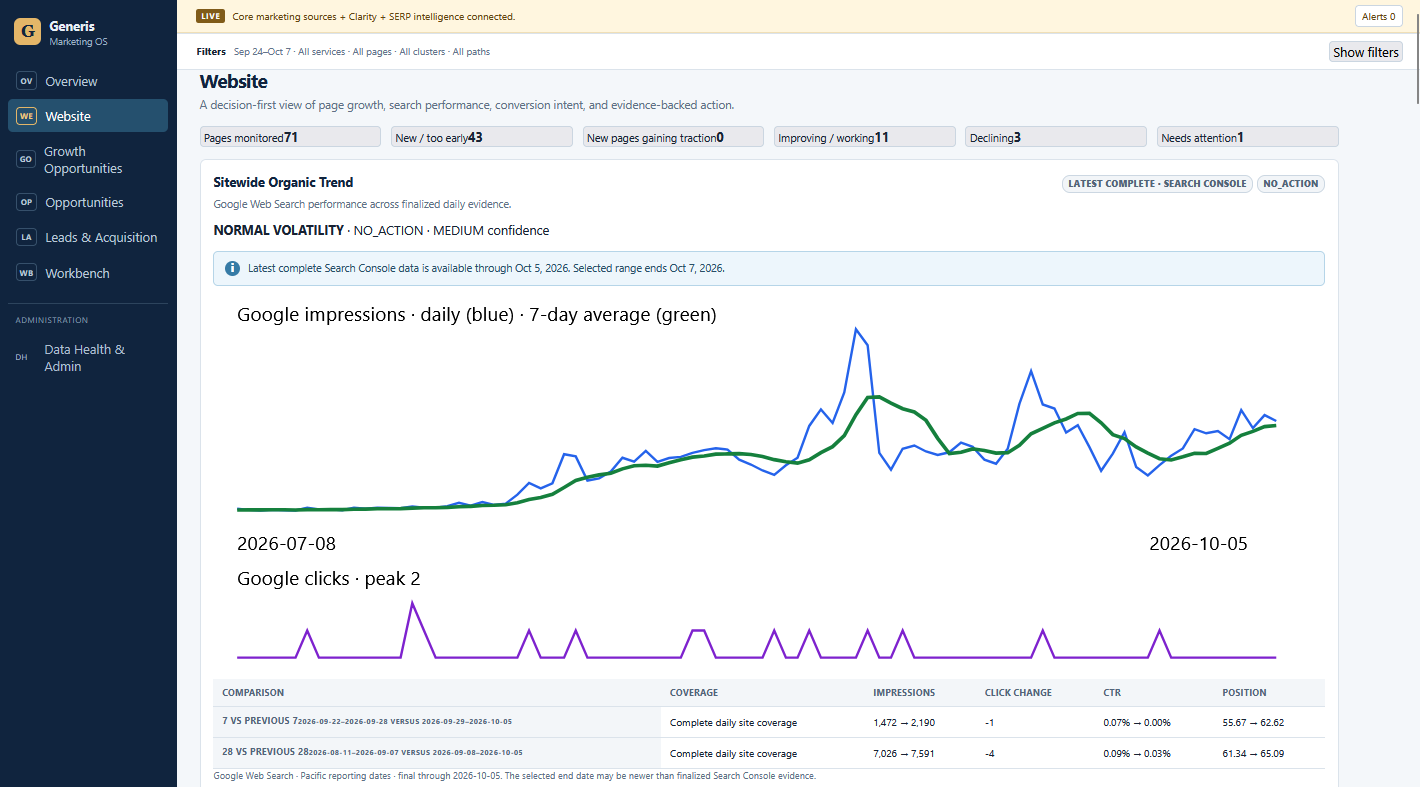
The interface helps inspect page trends, search context, reporting periods, and evidence coverage before deciding what deserves attention. It demonstrates reporting implementation—not SEO causation or improved rankings.
What we can work on
The right scope depends on the business, market, current site, eligible profiles, and available search data.
Pages built around real offers, customer questions, service areas, and useful next actions.
Review and supported improvements for accurate categories, services, hours, locations, and website destinations.
Canonicals, redirects, sitemaps, internal links, crawl access, structured information, and mobile issues.
Search Console and Bing evidence, where accessible, connected to pages and practical improvement decisions.
How a search project works
We avoid large lists of generic keywords and pages that repeat one another. The project should make the business more useful and understandable.
Clarify what the business offers, where it can serve, and which customer questions have commercial value.
Review the current site, supported listings, competitors, indexing signals, and available first-party search data.
Improve the pages, information, internal paths, and technical issues that most directly affect understanding and discovery.
Monitor eligible impressions, clicks, queries, page behavior, and inquiries separately so observations are not presented as guaranteed outcomes.
Connected work
Review the related implementation services or compare project options before deciding on scope.
Common questions
No. Google states that local results depend mainly on relevance, distance, and prominence, and no provider controls all ranking factors. We can improve eligible business information, pages, technical signals, and the evidence used to make decisions.
No. Pages should exist because they provide distinct value to customers. Near-duplicate city or keyword pages can create a poor experience and unnecessary duplication. We recommend focused pages only where the service, location, or customer need supports them.
Google and Bing say their existing search fundamentals still matter: public crawlable pages, clear structure, accurate information, and helpful original content. There is no special schema or file that guarantees inclusion in an AI answer.
Often. We first confirm whether the platform supports the content, technical, structured-data, redirect, and measurement changes in scope. A complete rebuild is not automatically required.
Where access and data exist, we can review Search Console or Bing impressions, clicks, queries, pages, and indexing alongside website actions and business records. Those sources answer different questions and should not be blended into an unsupported revenue claim.
Make the business easier to discover
Tell us what you offer, where you serve, and what customers should do next. We’ll help identify the website, local, content, and technical improvements that make sense for the current search foundation.